
Working Ranch Radio Show
Providing thought provoking information and resources for Ranchers that have a desire to be Responsible, Adaptive, and Profitable. From cows, to land, to people, and technology... issues every ranching business deals with. Hosted by Justin Mills, a 5th generation Wyoming Rancher. A production of Working Ranch Magazine.

10
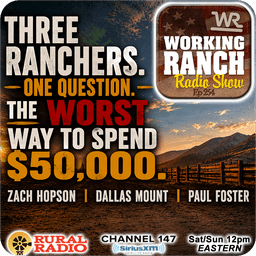
Ep 254: Three Ranchers. One Question. The Worst Way to Spend $50,000.
<p>If you had an extra $50,000 to invest into your ranch today… what’s the smartest way to use it?</p> <p>In part two of this special roundtable discussion, Zach Hopson, Dallas Mount, and Paul Foster discuss the worst ways to spend money, when equipment actually makes sense, paying down debt versus keeping cash available, and how ranchers are beginning to use AI and technology to improve decision-making, grazing management, and overall business efficiency. A practical conversation about deploying capital, managing risk, and building a stronger ranch business while cattle markets remain strong.</p> <p>Plus, a conversation on the f...

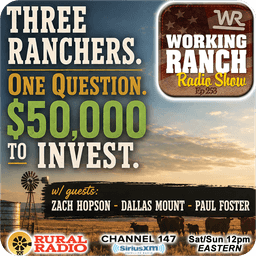
Ep 253: Three Ranchers. One Question. $50,000 to Invest.
<p>If you had $50,000 to invest into your operation today… where would it go? Today is part 1 of a 2-part conversation with three ranchers from different operations answer the exact same question. Zach Hopson from East Texas, Dallas Mount from Eastern Wyoming, and Paul Foster from Northern Wyoming each bring a different perspective shaped by their own environments, business structures, land access, risk tolerance, and long-term goals. From cattle trading and infrastructure development… to water projects, labor efficiency, diversification, working capital, and preparing the next generation… this conversation becomes much bigger than simply “how to spend $50,000.” It’s a practical, honest discussi...
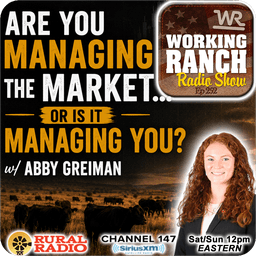
Ep 252: Are You Managing the Market… or Is It Managing You? w/ Abby Greiman
<p>Cattle markets are strong… but are producers truly managing risk, margins, and marketing decisions — or simply reacting to the market around them?</p> <p>This week Abby Greiman of Ever.Ag joins us for a practical conversation on cattle marketing, breakevens, risk management, and why surviving cattle cycles often isn’t about swinging for the fences. We discuss understanding your costs, putting a marketing plan in place, and utilizing tools that can help protect operations when markets eventually turn.</p> <p>#workingranchmagazine #WorkingRanchRadio #ranchlife #ranching #cattle #livestock #beef #cowcalf #cattlemarketing #riskmanagement #cattlemarkets #beefproduction #ranchprofitability #cattleproducers #agriculture #LRP #livestockriskprotection #EverAg #market...
Ep 251: Keeping Ranchers on the Land: The Mission of the Noble Research Institute w/ Steven Rhines
<p>Today we take a closer look at the mission behind the Noble Research Institute and what it means for the future of ranching in the United States. Steven Rhines, CEO and President of the Noble Research Institute, joins us to share the history of the organization, the vision that shaped it in the 1940s, and how that work continues today through a focus on soil health, grazing management, and keeping ranchers on the land. We discuss the challenges facing U.S. grazing lands, the loss of producers, and why the conversation has shifted from growth to preservation.</p> <p>...
Ep 250: Eminent Domain: What Landowners Need to Know w/ Tiffany Dowell Lashmet
<p>Today we take a closer look at Eminent Domain and what it means for landowners. Tiffany Dowell Lashmet, agricultural law specialist with Texas A&M University, joins us to walk through the basics of eminent domain, where the authority comes from, some of the common truths and misconceptions, and the practical steps landowners should—and shouldn’t—take if they find themselves facing it.</p> <p>Plus, as we head into fly season, we shift gears to a challenge every producer deals with—horn flies. How much are they really costing your operation, and why does timing matter when it comes...
Ep 249: Making Kentucky 31 Fescue Work—and What It Teaches About Grazing Management w/ Dr. Harley Naumann
<p>Kentucky 31 fescue—for some it’s tolerated, for others it’s hated. This week, Dr. Harley Naumann with the University of Missouri joins us to talk about how to manage Kentucky 31 fescue and make it work in a year-round grazing system. From avoiding toxicity to stocking rate, forage diversity, and matching cattle to available feed, the focus is on building a system that works—not just for ranchers in the fescue belt, but for operations everywhere. Plus, we look at the latest data on preconditioning calves and where it’s adding value in today’s market.</p> <p>#workingranchmagazine #WorkingRanch...
Ep 248: Does Grazing Under Pivots Pencil? w/ Race King
<p>What does it look like to shift irrigated pivot ground from crop production to grazing livestock? On today’s episode, Race King with the Matador Ranch joins us to share how their operation approached that transition. With over 20 years of experience, we discuss what led them to explore grazing under pivots, the steps they took to implement it, and the results they’ve seen over time. From labor and infrastructure to soil health and long-term economics, we explore whether this approach can work in other parts of the country—and how it performs across different market conditions. Plus, we take a...
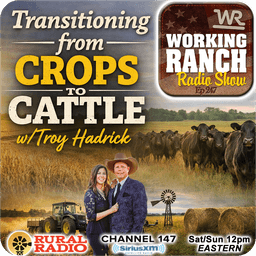
Ep 247: Transitioning from Crops to Cattle w/ Troy Hadrick
<p>What do you do when farming no longer pencils out? Today, South Dakota rancher Troy Hadrick (Hadrick Ranch) joins us to talk about transitioning from dryland crop farming to a cattle-focused operation. We discuss what drove that shift, how direct-to-consumer beef sales created new opportunity, and what it really takes—from water and infrastructure to working with the right partners—to make a transition like this work on the ground.</p> <p>Plus, we look at the new pheromone-based product called, CattleZen, designed to help reduce stress in calves during key management periods.</p> <p>#workingranchmagazine #ranchlife #ranching #cattle #beef...
Ep 246: Why Calves Crash Three Weeks After Weaning or a Stress Event w/ Dr. Blaine Ellison
<p>Why do calves often crash about three weeks after weaning or shipping? Today Dr. Blaine Ellison of Applied Bio Technologies, Inc joins us to explain the 21-day cortisol surge in cattle — a stress response that can suppress immune function, shut down weight gain, and increase sickness risk.</p> <p>In this episode we discuss:</p> <p>• Why cattle often stall out during the first 21–28 days after stress<br> • The evolutionary biology behind the cortisol surge<br> • How the immune system shifts metabolism during stress<br> • Management decisions that may unintentionally make the problem worse<br> • What producers might consider doing differentl...
Ep 245: How Artificial Intelligence is Changing Embryo Transfer w/ Cara Wells & Jarred Wareham
<p>Embryo transfer has long promised accelerated genetic progress, but with pregnancy rates sitting around 42%, producers are forced to ask hard questions about cost, risk, and return on investment. In this episode Cara Wells, founder and CEO of Emgenisys, shares how artificial intelligence is being used to analyze embryo viability before transfer. By capturing a brief video through a microscope and applying machine learning, embryologists can now receive a pregnancy probability score — helping improve decision-making, increase pregnancy rates, and better utilize valuable recipient females. Ag Tech Strategist Jarred Wareham explains why this may be one of the first truly practical appl...
