
The Agile Attorney Podcast
The Agile Attorney podcast teaches legal professionals how to streamline their legal workflows using the principles, practices, and tools of the Kanban Method. Join Accredited Kanban Trainer and award-winning legal operations professional John E. Grant as he shares the keys to implementing effective strategies, practices, and technologies to drive true efficiency in your legal processes. For more information on how John can help you develop an agile mindset and bust through your legal delivery bottlenecks, visit https://agileattorney.com. This is the show for you if you find yourself asking questions like: -How can I make my law practice more...

10

139. Two Metrics That Can Sabotage Your Law Firm Marketing
<p>Your law firm's marketing can be working exactly as intended while your practice is heading toward trouble. Bringing in more clients might seem like a sign of success, but if your delivery pipeline can't keep up, you could be creating problems that eventually undermine those efforts.</p><p></p><p>In this episode, I'm sharing a recent conversation with a law firm that illustrates a common blind spot in how practices measure success. We'll look at two metrics that need to be considered together, what happens when work continues to pile up, and why the bottleneck in your practice...


138. The Lawyer Shortage: New Data and What Law Firms Need to Know
<p>The lawyer shortage is real, and the latest data offers some signs of change. But a bigger pipeline of future lawyers does not mean law firms will be able to hire their way out of the problem anytime soon.</p><p></p><p>In this episode, I revisit my earlier look at the roots of the lawyer shortage to see what's changed. I also explain why investing in your existing people, improving your processes, and making better use of your technology can help your firm increase capacity and throughput while continuing to deliver value to clients.</p><p></p><...
137. It’s Not Procrastination; Overloaded Lawyers Struggle With (Ethical) Diligence
<p>Legal delays are often blamed on procrastination, but that is not what I see in the practices I work with. The problem is rarely that people are sitting idle. More often, good lawyers are buried under more work than their systems can reasonably handle.</p><p></p><p>In this episode, I explore the connection between ethical diligence and capacity discipline. I explain why managing workload, commitments, and work in progress is essential to keeping matters moving, and why too much work in the system can make it harder for lawyers to deliver the level of service their clients...

136. Law Firm Overload: Why Closing Just 5% of Your Cases Brings Big Relief
<p>Why does your law practice sometimes feel like it hits a wall overnight? The answer may not be that you suddenly have too much work. When your system is operating near capacity, even small changes can create major delays and bottlenecks.</p><p></p><p>In this episode, I explain why law firm overload happens and why the solution is often not working harder or adding more resources. I break down how capacity, utilization, complexity, and work in progress affect the flow of legal work, and why closing just a small percentage of your active matters can create significant...

135. What Business Clients Want From Their Law Firms with Stephanie Corey (Voice of the Client)
<p>What do business clients actually want from their law firms, beyond excellent legal work? For in-house legal teams managing tight budgets, growing workloads, and pressure from the rest of the business, the experience of working with outside counsel matters just as much as the legal expertise they provide.</p><p></p><p>This week, I’m joined by Stephanie Corey, founder of UpLevel Ops and co-founder of the Corporate Legal Operations Consortium (CLOC), who has spent 25 years on the buying side of legal services. We dig into what she has learned from working with more than 100 general counsels and ch...

134. Why Your Law Practice Should Avoid Diving Catches & Other Heroics
<p>Sometimes saving the day comes at a cost. After an unexpected problem forced me into a “diving catch” last week, I found myself dealing with the aftermath of pushing my capacity too far.</p><p></p><p>In this episode, I reflect on what happened and the lessons it reinforced about capacity, utilization, and sustainable work. I share why operating too close to full capacity leaves no room for unexpected challenges, how a lack of slack causes work to slow down, and why relying on diving catches and other heroics is a sign that something in the system may need...

133. How to Talk to Clients About AI [AI ROI Part 4]
<p>Your clients are probably already using AI to ask questions about their legal matters. The question is no longer whether they will use these tools, but whether they will use them with the right information and guidance.</p><p></p><p>In this episode, I explore why telling clients not to use AI may not be the most realistic or helpful approach. I explain what clients are getting from these tools, including instant access, the ability to ask unlimited questions, and a place to work through their concerns, while also discussing the risks they may not understand. I share...
132. When People Need Answers But Can’t Afford More Legal Help (Voice of the Client)
<p>People do not stop needing answers when they can no longer afford legal help. They still have questions, still need to understand what is happening, and still need guidance through unfamiliar processes. But when access to their attorney changes, they often have to find other ways to fill that gap.</p><p></p><p>In this episode, I revisit a conversation with Jason, a former divorce litigant who shares what it was like navigating the legal system as a client. We’ll explore the importance of setting expectations, helping clients understand how legal services work, and recognizing what happens wh...
131. Why Overdue Tasks Keep Piling up in Your Law Practice
<p>Overdue tasks are a frustrating reality for many law firms. But the problem is not always a lack of discipline or effort. Often, it is the way the system is designed to manage work.</p><p></p><p>In this episode, I explore why overdue tasks keep piling up in your law practice and why traditional task management approaches often make the problem worse. I explain how practice management software can create task overload by treating every matter independently instead of accounting for the team's shared capacity to complete the work.</p><p></p><p>Get full show notes...
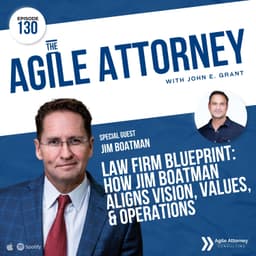
130. Law Firm Blueprint: How Jim Boatman Aligns Vision, Values, & Operations
<p>A law firm’s vision and values only create real impact when they influence the decisions people make every day. Many firms have mission statements that live on a website but never become part of how the organization operates. The challenge is turning those ideas into a practical framework that helps guide hiring, leadership, culture, and difficult decisions.</p><p></p><p>In this episode, I sit down with Florida-based litigator Jim Boatman to discuss the law firm blueprint he created to define his firm’s purpose, values, and operating principles. Jim shares how what started as a recruiting tool...
