

The Eric Ries Show
Founder, entrepreneur, and best-selling author of The Lean Startup Eric Ries discusses how to build profitable companies for the long-term benefit of society. Ries talks with world-class technologists, thought leaders, executives, and others working to create a new ecosystem of trustworthy organizations with limitless potential for growth and a deep commitment to purpose. Together, they uncover the tools and methods to ensure the next generation of companies are designed to maximize human flourishing for generations.

10
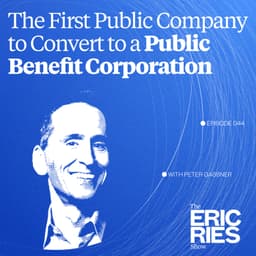
How Veeva Became the First Public Company to Convert to a Public Benefit Corporation | Peter Gassner
<p>What if maximizing shareholder value can actually make a company less valuable?</p><p>Peter Gassner is the founder and CEO of Veeva Systems, a cloud software company serving the life sciences industry. Before founding Veeva, Peter built enterprise software at IBM, PeopleSoft, and Salesforce. Under his leadership, Veeva became the first publicly traded company to convert to a public benefit corporation.</p><p>In this episode of The Eric Ries Show, Peter joins me to explain why profit is necessary for a healthy company but should be the result of fulfilling its mission, not the mission itself. We...

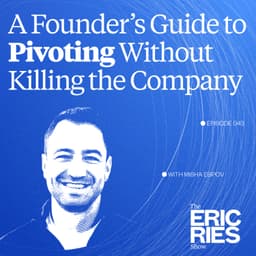
A Founder’s Guide to Pivoting Without Killing the Company | Misha Esipov
<p>Misha Esipov is the co-founder and CEO of Nova Credit. In this episode of The Eric Ries Show, I talk with Misha about what it takes to build a company inside one of the hardest parts of finance to break into.</p><p>Misha immigrated to the United States from the Soviet Union as a child and watched his parents rebuild their lives from scratch. Years later, after a conventional path through math, finance, and business school, that experience resurfaced as a question that wouldn’t let go. Why do capable people lose access to credit simply because they cr...
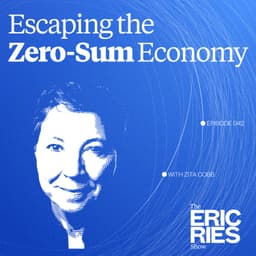
Escaping the Zero-Sum Economy: A New Model for Local Prosperity | Zita Cobb
<p>Zita Cobb grew up on Fogo Island, a remote fishing community off the coast of Newfoundland that operated for centuries without cash. Her childhood was shaped by a deep sense of place, the collapse of the inshore fishery, and a belief that communities survive through mutual care. When she left to study business, and later helped build JDS Uniphase into one of the most successful high-tech companies of its era, she carried those ideas with her. The rise and fall of the telecom bubble gave her a front-row view into what happens when profit and speed outrun purpose, sending...
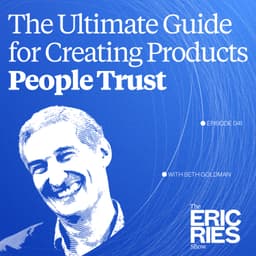
The Ultimate Guide for Creating Products People Trust | Seth Goldman (Honest Tea)
<p>Most companies scale by cutting corners. Seth Goldman built a brand by refusing to.</p><p>Seth is one of the founders of Honest Tea, a longtime chair at Beyond Meat, and the cofounder of Just Ice Tea. His career has been defined by a belief that business can be a force for human and environmental good. From a thermos of tea brewed in his kitchen to national distribution and acquisition by Coca-Cola, he has spent decades exploring how values can live inside systems built for profit.</p><p>In this episode of The Eric Ries Show, I sit...

How the Former U.S. CTO Built a $3B Healthcare Company Powered by Love | Todd Park
<p>Most companies optimize for profit. Devoted Health was built to serve people.</p><p>In this episode of The Eric Ries Show, I sit down with Todd Park, co-founder of Devoted Health and former U.S. Chief Technology Officer, to explore what it looks like to design a company for human flourishing at scale.</p><p>Todd shares how Devoted earned one of the highest trust scores in the industry and how he and his brother, Ed, built a business that treats every member like family. We talk about what it takes to operationalize love inside a system as...
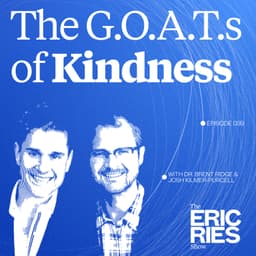
The G.O.A.T.s of Kindness on Bootstrapping a Purpose-Driven Company | Dr. Brent Ridge & Josh Kilmer-Purcell
<p>Most companies talk about purpose. Beekman 1802 made it their operating system.</p><p>In this episode of The Eric Ries Show, I sit down with Dr. Brent Ridge and Josh Kilmer-Purcell, co-founders of Beekman 1802, to explore how a small act of compassion grew into a multimillion-dollar skincare brand rooted in community and purpose.</p><p>After losing their Manhattan jobs during the 2008 recession, Brent and Josh moved to a farm in upstate New York and agreed to take in 80 homeless goats from a neighbor. That decision led to their first product, a bar of goat milk soap, and to...
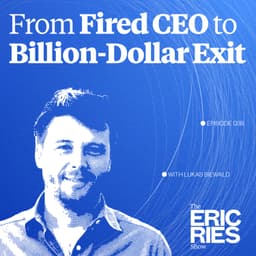
From Fired CEO to Billion-Dollar Exit: How Lukas Biewald Turned Failure into the Future of AI
<p>Lukas Biewald has been shaping the future of AI for nearly two decades. In this episode of The Eric Ries Show, we explore how his early passion for the board game Go, his hard-won lessons as a founder, and his focus on alignment and culture helped him build Weights & Biases into a trusted toolmaker in machine learning.</p><p>In our conversation, we discuss: </p><p>• Lessons Lukas drew from Go about pattern recognition, persistence, and the power of computation</p><p>• The hard-won lessons Lukas took from CrowdFlower about timing, focus, and staying in the wrong role too long<...
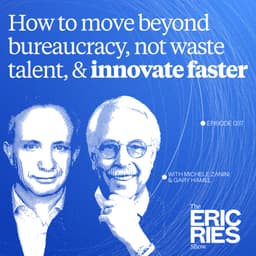
How to move beyond bureaucracy, not waste talent, and innovate faster | Michele Zanini & Gary Hamel
<p>Bureaucracy was once a breakthrough. Today, it’s become a costly drag on innovation, human potential, and business impact. In this episode of The Eric Ries Show, I sit down with Gary Hamel and Michele Zanini, authors of Humanocracy, to explore how organizations can move beyond outdated management models and unlock true human thriving.</p><p>Hamel and Zanini have spent years researching and advising some of the world’s most forward-thinking companies. Together, we make the case for replacing top-down control with systems that maximize contribution, creativity, and ownership at every level.</p><p>We dive into how to r...
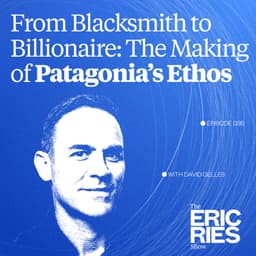
From Blacksmith to Billionaire: The Making of Patagonia’s Ethos
<p>Patagonia has always been different. While so many companies lose their way when profits come before people, the planet, or even their own products, Patagonia continues to stay true to its values.</p><p>In today’s episode of The Eric Ries Show, I speak with journalist David Gelles, author of Dirtbag Billionaire, his new book about founder Yvon Chouinard. We explore how Chouinard built Patagonia with an ethos of quality and conservation, how he resisted the corrupting pull of profit-at-all-costs, and why he ultimately gave the company away to protect its mission.</p><p>We talk about what Pa...

“AI Will Break the Internet” — Cloudflare CEO’s Big Prediction
<p>What if your company’s mission turned out to be bigger than you imagined?</p><p>In this episode of The Eric Ries Show, I speak with Matthew Prince, co-founder and CEO of Cloudflare, now a $70 billion company defending 20% of all internet traffic. We trace how Cloudflare’s mission wasn’t declared at the start, but discovered through a series of principled decisions, from protecting journalists and activists to making encryption free for everyone.</p><p>We also explore today’s urgent challenges: how AI’s shift from search engines to answer engines threatens the web’s business model, why creators...
