
TrustTalk - It's all about Trust
Trust is the invisible force that shapes our world, and at TrustTalk, we're committed to exploring its many dimensions. Join us as we engage with thought leaders from all walks of life to discuss the role of trust in every aspect of our world. From personal relationships to business, technology, society, and beyond, we explore the wonders of this essential human emotion. It's a journey you won't want to miss.

10
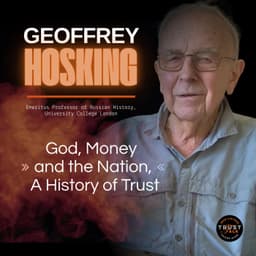
God, Money and the Nation, A History of Trust
It opens in one of Stalin's prisons: a condemned man writing to the very dictator about to have him shot, still pleading to be trusted. From that chilling scene, historian Geoffrey Hosking sets out to explain one of history's strangest achievements: how we ever learned to trust far beyond the people we know. In Trust: A History, he traces that story across the centuries - through religion, money, and the nation - then carries it right up to now: Russia and Ukraine, an America that no longer looks like the anchor it once was, social media, and the risk of...

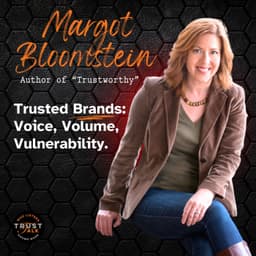
Trusted Brands: Voice, Volume, Vulnerability
If you build or look after a brand, this is a practical half-hour on the one thing every marketing budget quietly rests on: earning trust and keeping it. Before you read a single word on a website or pick a product off the shelf, you've already decided whether you trust it — in about seven seconds, just from how it looks. So how do the smartest brands earn that trust? This week's guest is Margot Bloomstein, brand and content strategist, founder of the Boston consultancy Appropriate, Inc., and author of Trustworthy: How the Smartest Brands Beat Cynicism and Bridge the Trust Ga...
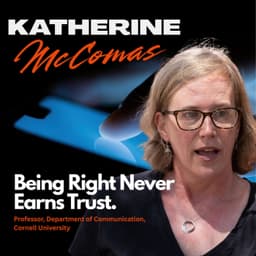
Being Right Never Earns Trust
Most people think an institution earns trust by being right. Katherine McComas thinks it earns trust by asking, and after a career studying what happens when science and power arrive in a community's own backyard, she has the cases to prove it. We talk about Cornell's Lake Source Cooling - a project so clean it cut the university's carbon footprint, yet fractured its relationship with the town next door for more than twenty years. Not because the science was wrong, but because of how the decision was made, and who was never asked. And why the same small earthquake is...
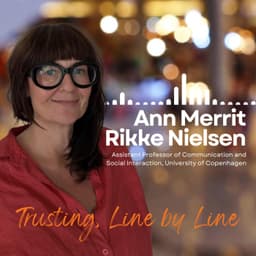
Trusting, Line by Line
Most people think trust is something you either have or you don't. Ann Merrit Rikke Nielsen, assistant professor at the University of Copenhagen and vice director of Centre for Interaction Research and Communication Design (CIRCD,) thinks it is something you build, one turn of conversation at a time. In this episode, we talk about why trust is nearly invisible until the moment it is tested, and why Ann stopped trusting surveys and interviews to study it. Instead, she records real conversations between social workers and the vulnerable citizens they support, and listens back - sometimes pause by pause - for th...
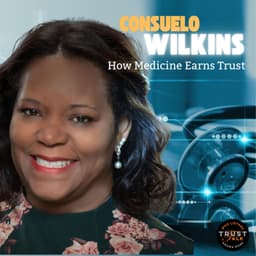
How Medicine Earns Trust
What does it actually take for a hospital, a research institution, or a public health agency to deserve the trust of the communities it serves? Consuelo H. Wilkins has spent her career asking that question — not as a philosopher, but as a physician who sees patients and as a researcher who has built the tools to measure whether trust is really there. Prof. Wilkins is Professor of Medicine and Senior Vice President at Vanderbilt University Medical Center in Nashville, Tennessee, where she also holds the Mildred Thornton Stahlman Chair in Rural Health. She led the development of Vanderbilt's Racial Equity Pl...
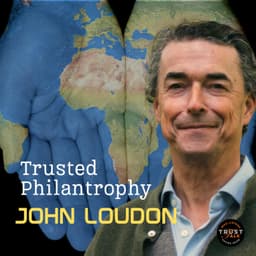
Trusted Philantrophy
Most people think philanthropy is about money. John Loudon, Executive Director of the COmON Foundation and one of the best-known philanthropists in conservation and nature preservation, with a career spanning three decades across Europe and Africa, thinks it is about trust. In this episode, we talk about what happens when trust is missing from giving, how philanthropy becomes distant, data-driven, and ultimately ineffective. And what it looks like when trust is genuinely present. John brings two stories to illustrate this. One from Malawi, where a community that had been depleting a national park for survival became its guardian angels once...
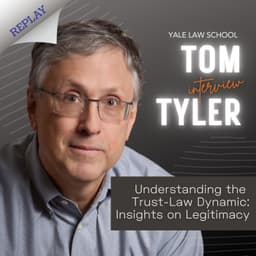
Understanding the Trust-Law Dynamic: Insights on Legitimacy
In this replay of a 2023 interview, Severin de Wit speaks with Tom Tyler, professor of law and psychology at Yale and founding director of the Justice Collaboratory. A psychologist teaching in a law school — a rare combination — Tyler argues that legal systems are built on assumptions about human nature that are seldom tested against what psychologists actually know. His research points to something striking: people comply with the law more because they trust it than because they fear it. And what builds that trust is not whether you win or lose your case, but how you were treated along the way...
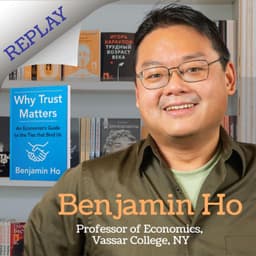
Why Trust Matters
In this replay of a 2023 interview, Severin de Wit speaks with Economist Benjamin Ho - Professor of Economics at Vassar College and author of Why Trust Matters: An Economist's Guide to the Ties That Bind Us. What if trust isn't just a feeling, but something humans have been calculating for thousands of years? Ben Ho uses game theory to explain why we cooperate at all, why we keep promises that cost us, and why the words I am sorry almost never work the way we expect. Ben explains why an apology only repairs trust when it carries a real cost...
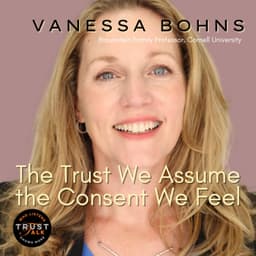
The Trust We Assume, the Consent We Feel
Imagine standing in a busy train station, asking strangers to answer a few questions. How many people would you need to approach before five say yes? In a now-classic study, Vanessa Bohns predicted twenty. The actual number was ten. People were almost twice as likely to agree as she expected, and two decades and more than 14,000 requests later, the finding still holds. We consistently underestimate how often others will say yes to us, and how hard it is for them to refuse. This is really a conversation about trust. We tend to assume that when someone agrees to a request...
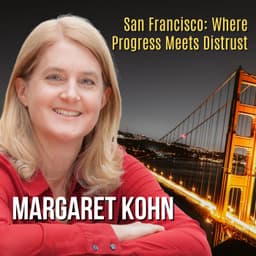
San Francisco: Where Progress Meets Distrust
We tend to think of trust as something that grows where people agree. Where neighbors share values, where voters share a party, where a city sees itself as forward-looking and inclusive. The more common ground, the more trust. That, at least, is the intuition. San Francisco complicates that picture. Eighty per cent of voters belong to the same party. Almost everyone calls themselves progressive. The city is wealthy, diverse, and proud of both. And yet, by one well-known measure, it is also among the least trusting cities in the United States. The deepest political conflicts are no longer between left...
