
Real Estate Investing for Cash Flow with Kevin Bupp
There are a lot of real estate podcasts out there, most of which focusing on the residential fix and flips or wholesaling, but Kevin Bupp believes there's a smarter way to build long term cash flow and generational wealth. On the Real Estate Investing For Cash Flow podcast, you'll learn firsthand how the most successful commercial real estate investors in the world have learned to leverage their multifamily and commercial properties to create a steady stream of passive income. We'll spend time with industry experts who will teach you how to take your Real Estate Investing business to the next...

10

Making $40,000+ Profit Per Deal & Building 50+ Affordable Homes a Year | Ep. 1009
<p >Providing affordable housing and making a profit don’t have to be mutually exclusive. One small real estate business has found a way to deliver brand-new homes in a lower price range and generate sizable margins.</p><p > </p><p >Using land home packages, Chris Gavre and his partner build and sell roughly 50-60 homes per year while also addressing the affordable housing problem in his market of Greenville, South Carolina. The strategy is simple: buy and prepare an empty lot, install a manufactured house, and sell it for a sizable profit. Despite each project taking only 45-60 days to...

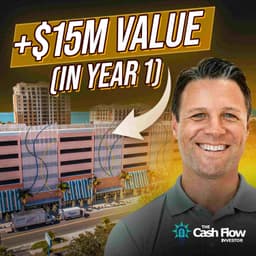
Real Deals: We Created $15M in Value on This Commercial Property (In Year One)
<p >Some commercial real estate investments don’t look like obvious winners on the surface. Complexity, uncertainty, and unanswered questions scare many investors away, but they can also lead to some of the best opportunities. That was certainly the case with the deal I’m about to show you: a great asset, in a great location, with more than a few hurdles along the way.</p><p > </p><p >Today’s Sunrise Capital Investors case study involves a $33.2 million parking garage in Clearwater Beach, Florida. This was one of the most complex projects we’ve ever taken on, but through conservat...

When We Say “No” to a Great Deal (Even If It Fits Our Buy Box) | Ep. 1007
<p >Commercial real estate acquisitions doesn't simply mean finding a deal, underwriting it, and hoping for the best. Often, having the discipline to act on what you find will make you wealthier than even the greatest properties you could buy. Every investment has skeletons in the closet, and even if the problems you inevitably uncover are fixable, some just aren’t worth fixing. So when do you draw the line even after you’ve fallen in love with the deal?</p><p ><br></p><p >Today, I’m speaking to my partner and CEO of Sunrise Capital Investors, Brian Spear. We sta...

These “Durable” Commercial Real Estate Investments Will Pay You for Decades | Ep. 1006
<p >What separates a piece of commercial real estate that doesn’t survive from one that endures for decades—and through multiple market cycles? It’s a question Ed Pitoniak, founder and CEO of VICI Properties, has spent the last several years working to answer.</p><p > </p><p >Today, Ed leads one of the nation’s largest owners of experiential commercial real estate. But he took an unconventional path to get there, starting at a ski publication before moving into hospitality and, eventually, real estate.</p><p > </p><p >Along the way, he forged the skills and perspective needed to navigat...

He Walked Away Mid-Deal. It Cost Him $100,000 (But Saved His Investors)
<p >Real estate investing demands conviction, but when market conditions shift—sometimes even mid-deal—do you stick to your guns or walk away?</p><p > </p><p >August Biniaz, CIO and co-founder of CPI Capital, found himself toeing this exact line shortly after underwriting and raising capital for a large, build-to-rent community in Tucson, Arizona.</p><p > </p><p >When interest rates spiked, the deal no longer penciled, but exiting meant sacrificing significant time and over $100,000 in sweat equity. On the other hand, moving forward meant potentially putting investor capital, and their reputation, at risk.</p><p > </p><p >Rather than ra...

99% Passed on These Commercial Properties. They Made Him a Fortune.
<p >After more than 50 years in commercial real estate, Bill Cummings has built an 11-million-square-foot portfolio spanning 12 communities around Greater Boston. But he did so by ignoring many of the conventional rules of real estate investing.</p><p > </p><p >When his peers suggested he explore new markets, he stayed local. When others urged him to sell, he continued to hold for decades. And when other developers steered clear of neglected buildings, Bill saw opportunity, transforming overlooked properties for enormous profits.</p><p > </p><p >This contrarian approach hasn’t just helped shape the culture at Cummings Properties; it’s also c...

He Tripled His Cash Flow by Doing What Most Buy-and-Hold Investors Won’t | Ep. 1003
<p >Early on, most real estate investors are chasing the same thing: more. More properties. More units. More cash flow. But eventually, “more” becomes a trap.</p><p > </p><p >Every acquisition brings new challenges and risks. At some point, the smartest move isn’t buying more. It’s pruning. Chris Lopez, co-founder of Property Llama and host of the PassivePockets podcast, argues that investors should act more like fund managers by routinely reassessing, rebalancing, and reprioritizing their investments.</p><p > </p><p >Because the “buy and hold” strategy has a potentially dangerous blind spot: not enough investors consider the exit, or wheth...

How to Earn a 13%-18% Average Annual Return in 2026 (Tax Lien Investing 101) | Ep. 1002
<p >Tax liens are often pitched as a passive way to earn double-digit returns from investments that are backed by real estate.</p><p > </p><p >This is only half true.</p><p > </p><p >While these investments average 13%-18% annual returns, they may actually be one of the least passive investing strategies. With roughly 20 years of experience as a real estate investor, attorney, and title professional, Stephen Morel understands all that this strategy entails better than most.</p><p > </p><p >The truth is that most investors are thinking about these investments the wrong way. Tax liens aren’t a sho...

The State of Affordable Housing in 2026 w/ BOXABL CEO Galiano Tiramani | Ep. 1001
<p >America’s affordable housing crisis is well documented. We’re currently short millions of homes, and the number doesn’t seem to be going down.</p><p >The problem is more complicated, but more solvable, than it appears. Factory-built housing—such as manufactured and mobile homes—has helped fill the gap for decades, and the capacity to build substantially more already exists.</p><p >Now, new products are entering the market. Galiano Tiramani, co-founder and CEO of modular home manufacturer BOXABL, is spearheading the effort to produce their own model of affordable housing at scale.</p><p >But as you’re abo...

The Keys to a Tax-Efficient Real Estate Exit (1031 Exchanges, DSTs, & More) | Ep. 1000
<p >Real estate investors spend years mastering skills like analyzing deals, raising capital, and improving operations, but far less time thinking about one of the most important decisions they’ll ever make: the exit.</p><p >Mike Hart, chief financial officer here at Sunrise Capital Investors, believes you should start planning your exit roughly a year prior to the actual sale, as this affects when you’ll pay taxes, what you’ll pay, and depending on the strategy, if you’ll pay at all.</p><p >With over 30 years of commercial real estate experience, Mike has helped countless investors make smarter...
