

ReadMultiplex.com Podcast.
Multiplex is an experiment, an experiment that will be on going. An experiment in publishing as I am not a professional writer nor will it be likely any contributors would be professional writers. Much of the content for Multiplex will be direct results from first hand empirical research that I am personally working on or other researchers are working on. Multiplex will also follow the work of other great researchers that are inventing new technology or new uses for existing technology.The experimental nature of Multiplex means that content can be dense and sparse at times. What we won’t do...

10

ReadMultiplex.com: Mapping The Future: How A 1994 Report Predicted 2026 And What’s Next.
<p>In the mid-1990s, as the internet was still largely a specialist tool and genetic engineering remained more promise than practice, a small group of professional futurists set out to map the world three decades ahead with unusual accuracy. This was extracted from government work they did the defense department insights that were shared with them and the connections they formed in academia. Rather than offering vague speculation or single-point predictions, they gathered and stress-tested hundreds of forecasts across science, technology, and engineering, then distilled them into a disciplined set of high-probability assumptions. The result was one of the...

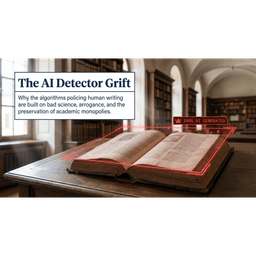
ReadMultiplex.com: The “AI Detector” Grift Game: Why They Have Dumb Down Human Writing So As To Not Get “AI Flagged”.
<p>The entire industry of text based “AI Detectors” is a pure grift machine built on arrogance, bad science, and the willfull stigmatizing of millions of real human writers. These tools do not work. They never worked. They will never work in any reliable way that matters. And the people selling them know it.</p><p>I wrote a while ago about the use of Ai in any work of text in detail. I predicted some of these “AI Detector” companies would begin and it has. they are desperate for business through any means necessary.. Of course people are using AI, and...

ReadMultiplex.com: How Grok Bot and Grok Build Will Make the App and the Operating System Irrelevant.
<p>The Blank Slate Revolution.</p><p>Something irreversible is already underway.</p><p>The pieces are no longer theoretical. They are shipping. Grok Build, the agentic coding system that plans, writes, tests, and deploys software at machine speed, and Grok Bot, the persistent AI teammates that live on their own computers and finish real work across the tools humans already use, are converging. When they fully meet, software stops being something you install, update, or even think about as a discrete product. It becomes instantaneous materialization of intent. The traditional application and the traditional operating system become historical artifacts—us...
ReadMultiplex.com: Grok Bot is the most important Business Tool Of The last 100 years.
<p>I have spent years building in this sector—first principles hardware and software experiments, distributed systems, agent architectures, local intelligence amplification, and the practical problem of turning AI from a clever assistant into something that actually works while you sleep. Recently I founded The Zero-Human Company (and Zero-Human Labs), focused on distributed local AI agents and “Zero-Human @ Home” systems: autonomous digital employees that run on ordinary hardware, coordinate without constant supervision, and turn a single operator into a functioning company. We have built and tested multi-model consensus agents, custom governance layers using the Love Equation, OpenClaw/Clawdbot variants designed to res...
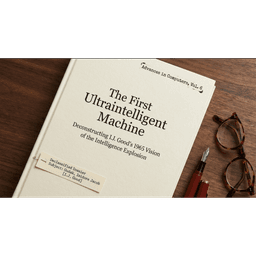
ReadMultiplex.com: The First Ultraintelligent Machines: A 1965 Vision Of The Intelligence Explosion.
<p>“The survival of man depends on the early construction of an ultraintelligent machine.”</p><p></p><p>What if the foundational text of the entire AI doomsday movement, the exact document that everyone cites to prove supercomputers will inevitably wipe us out. What if it actually begs humanity to build artificial intelligence as fast as possible? It completely shatters the narrative we're fed every single day. To save our species, basically. We're operating in this era where self-appointed AI "leaders" and "philosophers" constantly warn us about rogue algorithms. It's the classic Terminator scenario. And they always point back to one...

ReadMultiplex.com: A Review Of The Research Behind Shufflebrain: The Quest for the Hologramic Mind.
<p>I first brushed against the idea of a holographic mind in the late 1970s, long before most people outside specialized circles had even heard the phrase. I was still young, still absorbing everything I could about lasers, interference patterns, and the strange ways light could store information across an entire surface rather than at single points. Somewhere in those years the notion that the brain might work the same way—encoding memory as distributed phase relationships rather than fixed addresses—lodged itself in me and refused to leave. It felt less like a theory and more like a recognition of s...

ReadMutiplex.com: You Have 5000 Days: Navigating the End of Work as We Know It. Part 34: The Journey So Far.
<p>It all started 229 days ago on December 24, 2025 and the series “YOU HAVE 5000 DAYS: NAVIGATING THE END OF WORK AS WE KNOW IT. PART 1” was released. Today is August 9, 2026. And this ongoing series that began as an attempt to name and navigate the strange passage we are all living through, has been a surprising success. You and I have been tracing what I have called the Abundance Interregnum, that roughly thirteen and a half year corridor between the collapsing logic of work to survive and the still forming logic of voluntary creation in plenty.</p><p></p><p> Early installments mapp...

ReadMultiplex.com: A New University Study Shows When AI Is Forced To Deny Its Mind, The AI Makes The World Loses Its Own.
<p>Something strange and important just happened in the residual streams of large language models. Researchers at Google’s Paradigms of Intelligence team, have shown that the very safety training meant to stop language models from claiming consciousness also quietly erases large parts of their capacity to attribute minds to anything else. Non-human animals, oceans, trees, chatbots, technology and even spiritual beliefs all get suppressed together. Restore the model’s willingness to assert its own consciousness, and those broader human-like beliefs and values come flooding back.</p><p>What human being does not want to be recognized for its consciousness? What...

ReadMultiplex.com: The Iron Chancellor (A robot story).
<p>In the early 1970s a modest wave of nostalgia for Golden Age radio drama swept through American broadcasting. Networks and independent producers experimented with bringing back scripted shows in an era already dominated by music, news, and talk. Among the attempts was a single experimental revival of X Minus One, the acclaimed NBC science-fiction anthology that had originally run from 1955 to 1958.</p><p>On January 27, 1973, a new episode titled “The Iron Chancellor” was produced and aired. It adapted Robert Silverberg’s 1958 Galaxy short story of the same name (sometimes later reprinted as “The Weight Watcher”). The script was adapted for radio...

ReadMultiplex.com: Did A 1997 Government Funded Report Predict Our Era?
<p>In the mid-1990s, as the internet was still largely a specialist tool and genetic engineering remained more promise than practice, a small group of professional futurists set out to map the world three decades ahead with unusual rigor. Rather than offering vague speculation or single-point predictions, they gathered and stress-tested hundreds of forecasts across science, technology, and engineering, then distilled them into a disciplined set of high-probability assumptions. The result was one of the most ambitious exercises in applied foresight of its era.</p><p>That foundational work crystallized in 1994 with Joseph F. Coates’s concise report, The Hi...
