

Solo Founders
The Solo Founder's Podcast features in-depth interviews with solo founders building remarkable companies. Each week, host Julian Weisser sits down with solo founders who are either operating at serious scale or doing something right now that you need to know about. From Series B and beyond to founders breaking out in real-time, these are the conversations that define what it means to build solo. New episodes every week.

10
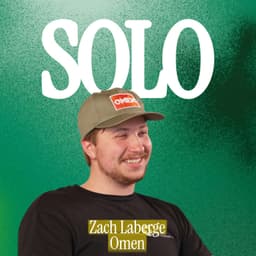
No Co-Founder, No Degree, $41.5M to Fix AI Data Centers | Zach Laberge, Omen
<p>Zach Laberge dropped out of high school to build his first company. His second, Omen AI, puts real-time sensors inside the fluids that keep AI data centers and industrial machines running. He's 20, has no co-founder, and has raised $41.5M. He explains why having no technical co-founder forced him to learn spectroscopy himself, and why that made him better.</p><p>Topics covered:<br>- The shutdown test: how to know when to stop, and how to wind down well<br>- Restarting from your strengths: $3M raised in three days from the buyers who'd said no<br>- Customer-led...

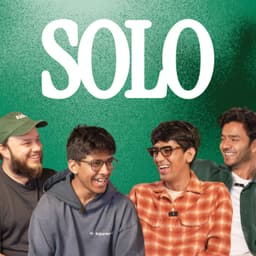
Searching For A Co-Founder Is How You Get A Bad One | 4 VC-Backed Solo Founders
<p>It's been a year since the Solo Founders Program kicked off. Today, the first cohort sits down to discuss building solo, together.</p><p>What a year of building taught them: why retention is growth (the smile curve, and the leaky bucket nobody checks), why free users are a "free trend" and not a business, how to kill a good idea to find the better one, and what a room full of other founders actually gets you. Plus the stories they lived before going solo — including co-founding with your dad at 17.</p><p>Topics covered:</p>The prerequisite trap: wh...
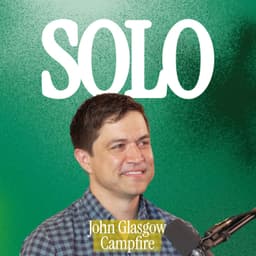
Non-Technical, No Co-Founder, $100M+ Raised | John Glasgow, Campfire
<p>John Glasgow is the anti-pattern founder: non-technical, 36 when he started, a newborn at home during Y Combinator, and solo after his co-founder left within weeks. After 15 years in corporate finance at Adobe, Fidelity, and Invoice2go, he built Campfire, the AI-native ERP fast-growing companies use to replace legacy systems. This is one of the most tactical conversations we've recorded.</p><p>Topics covered:</p>The "right to win" filter: which ideas deserve your resignation letterThe enterprise sales playbook from the buyer's side: champions, the $95K threshold tactic, budget cyclesSurviving two years pre-product-market fit as a solo founderFounding at 36 with...
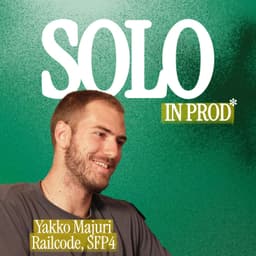
Why PostHog's 6th Employee Went Solo | Yakko Majuri, Railcode
<p>Companies are handing every employee AI coding tools and calling themselves AI-native — then blocking everything those employees build. Yakko Majuri, early PostHog engineer and infrastructure lead at Doublepoint through its acquisition by Oura, just launched Railcode: a secure home for internal apps and AI agents where you build with your own tools and deploy in seconds. He gives a live demo — Railcode's first on camera — and explains why most software going forward will be internal.</p><p>Topics covered:</p>The "AI-forward" illusion: giving out Claude Code isn't a strategyThe one-question test: are you holding your team back?Why most s...
AI Can Build Your App. It Can't Make It Good. | Paul Bakaus, Impeccable
<p>Paul Bakaus created jQuery UI, sold a startup to Zynga, and spent nearly a decade at Google — then went solo to prove one experienced builder, amplified by AI, can do what used to take a team. His company Renaissance Geek is backed by a16z; its first product, Impeccable, stops AI coding agents from shipping design slop.</p><p>Topics covered:</p>Why his first hire was a chief of staff, not an engineer (the middle-manager trap)The era of the 40-year-old founder: intuition and craftsmanship as leverageWhat Impeccable is and why AI design slop is a moving targetFree-first di...
What It Actually Takes To Build a Startup Solo | 6 VC-Backed Successful Solo Founders
<p>Everyone thinks going solo means answering to no one. Six solo founders behind WorkOS, Fondo, Plug, Lighthouse, Hamlet, and Julius AI say the opposite: you have more bosses, not fewer, and the job is convincing all of them. Julian revisits the six moments that deserved more attention the first time around.</p><p>Topics covered:<br>- Why going solo means more convincing, not less (Rahul Sonwalkar, Julius AI)<br>- The original-insight test: "if you don't have one, don't start" (Sunil Rajaraman, Hamlet)<br>- The "wrong" business model behind a 16-to-429 hockey stick (Jimmy Douglas, Plug)<br>...
She Staffed Her 100k-User Startup With AI Agents | Claire Vo, ChatPRD
<p>Claire Vo runs ChatPRD — an AI "Chief Product Officer" for over 100k product managers — as the only full-time human, bootstrapped, with zero venture capital. The twist: she operates the company with a staff of nine named AI agents she manages like real employees, one of whom emailed the studio before she arrived to coordinate arrival time. She and Julian dig into how she built it, why she runs nine scoped agents instead of one, and the honest case for and against going completely solo.</p><p>Topics covered:</p>The one-person company: running a real business with a team of A...
How To Get $1,000 For Your Project, No Strings Attached | Solo Grants
<p>Today we're launching Solo Grants: $100–$1,000 grants, 100% no strings attached, for people building technically ambitious projects solo. Julian sits down with Ari Dutilh who leads the program and is a former grantee himself, to map the wide world of microgrants and explain why the gap between a project seen through and one abandoned is usually just a few hundred dollars.</p><p>Topics covered:</p>The Solo Grants launch: $100 to $1,000, no equity, no payback, and it doesn't have to be a businessMicrogrants 101: 1517's $1,000 checks, Emergent Ventures, and the Thiel Fellowship lineageThe grantee who asked for $100 less than his application, and th...
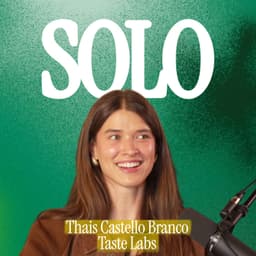
She Raised $18M Solo to Kill AI Slop | Thais Castello Branco, Taste Labs
<p>Thais Castello Branco left the AI search company Exa, raised $18.5M, and built Taste Labs -- the "taste layer for AI" -- solo, with one mission: end AI slop. She and Julian go deep on what taste actually is (and why it isn't personalization), why everything AI makes is starting to look the same, how you turn something as subjective as "great design" into data a model can learn, and the honest case for going solo.</p><p>Topics covered:</p>Why taste is a measurable bar for quality, not just personal preferenceThe real cause of "AI slop" — volume, no...
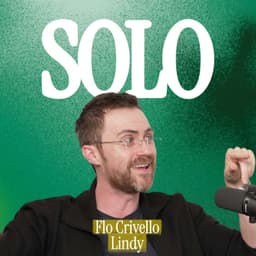
Going Solo Should Be the Rule, Not the Exception | Flo Crivello, Lindy
<p>Flo Crivello raised about $50M as a solo founder, then watched the market kill the company he'd built. Instead of quitting, he cut deep, pivoted, and rebuilt alone into Lindy — one of the top AI agent startups. This is a clear-eyed playbook on knowing when to kill a company, beating burnout with momentum, and building solo without being alone.</p><p>Topics covered:</p>Raising ~$50M as a solo founderKnowing when to kill a company and how deep to cutWhy momentum, not rest, is the cure for burnoutProspecting for gold vs. operating the mine: where a founder should spend th...
