

M&A Science
M&A Science, hosted by Kison Patel (Founder & CEO of DealRoom), is your go-to podcast for mastering the art of mergers and acquisitions. Each week, Kison and his expert guests from leading brands like Xerox, FastLap, and Cisco dig deep into real-world M&A strategies, offering actionable insights to optimize your M&A practice. Whether you're an experienced practitioner or new to the field, M&A Science provides practical advice on key topics like sourcing, due diligence, integration, divestitures, and more. With over 300 episodes, this podcast is the premier thought leadership resource designed to streamline your deal-making process. Start listening...

10

M&A's Sales Diligence Blind Spot: What 5 CRO Tours Taught John McMahon
<p >Most buyers diligence a sales org by ranking the reps and cutting the bottom of the list. But if you ask John McMahon, that's usually the wrong target. In most cases, the problem is the manager.</p> <p >John should know, because he's seen both sides of a sales integration. Cisco bought GeoTel, scattered its 50-rep software team across a router sales force, and lost nearly all of them. BMC bought BladeLogic, put John in charge of all of BMC sales, and took average rep productivity from $1.17 million to $2.23 million in a year.</p> <p >In this conversation, John...

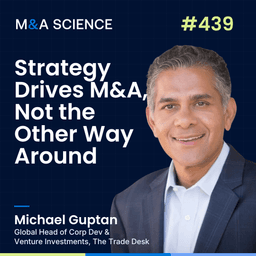
Strategy Drives M&A, Not the Other Way Around
<p >Most corp dev teams let the banker inbox set the agenda. Michael Guptan, who has led or contributed to 120+ transactions worth over $100B across Dell, Walmart, DXC, and now The Trade Desk (NASDAQ: TTD), says that's backward. Strategy drives M&A.</p> <p >His approach starts long before a deal. Define where the company needs to be in three to five years, find the gaps, then build relationships with likely targets 12 to 18 months before any deal talk, so culture is clear before the LOI.</p> <p >Michael and Kison cover:</p> The red flags that signal a culture mismatch...

How to Get to Yes
<p >Most people assume the hard part of an M&A deal is getting the contract signed. However, Meg Cavanaugh, SVP of Legal at Commvault (NASDAQ: CVLT), has spent her career proving otherwise.</p> <p >Meg worked in-house at three public companies, closing acquisitions almost every week during her six years at Carbonite before moving to Commvault, where her role spans legal, diligence, and integration. </p> <p>What You'll Learn</p> <p >Draft the LOI in-house before outside counsel sees it. Keep the tone and structure matched to your own deal philosophy, then bring outside counsel in to review rather t...

M&A Horror Stories
<p >A partner's spouse joined a call two weeks from closing. One background check later, a PE deal was dead, along with every dollar spent on diligence and attorney fees.</p> <p >Kison gathered the deal stories practitioners leave out of case studies, with the names removed. Corporate development leaders, attorneys, and advisors share deals that died at the signature line. There's also a roughly $1 billion divestiture that was unwound after a withheld forecast surfaced the morning after the wire. And a losing bidder bought the same company back 18 months later for about 80% less. The pattern across them: a late...

The Vendor Trap That Derails Carve-Outs
<p >Days before closing a carve-out, Danielle Fortier's team found the seller's vendor list was off by dozens of vendors. Danielle, a partner at Cooley with four corporate carve-outs closed this year, explains why: back-office vendors are shared across every business line, and deal leads rarely focus on them early.</p> <p >Her roadmap maps every entanglement, checks it against what the buyer already has, and sends only true gaps to the TSA. Cloud hosting, finance and IT security are the usual traps. Settle TSA length and pricing in the LOI. She has seen sellers assume three months while buyers...

How to Build Trust and Leverage in M&A
<p >"Never use the word 'trust me.' It's those people you can't trust." Jerry Cedicci, Kison Patel's boss from twenty years ago, built hundreds of millions of dollars in real estate, cafes, hotels, and restaurants. This is his playbook.</p> <p >For Jerry, trust is structural. Ask to run the business you're buying, let the seller fire you anytime, and hand them every card so they can't lose. He pushes the other side to name a price first so he never negotiates against himself, and he'll pay full price when the seller finances it.</p> <p >Then Kison raises...

The Man Who Taught Kison Patel to See M&A Opportunities
<p >"At the closing table, I left with a check of $10 million." Jerry Cedicci bought a run-down Chicago hotel for $14 million and sold it for $24 million within a year.</p> <p >Jerry grew up in a French orphanage and arrived in the US in 1981 barely speaking English. Kison Patel hunted properties with Jerry about 20 years ago and learned much of his dealmaking from him. When a bank rejected Jerry's loan, he asked exactly why and got $3 million from the next bank.</p> <p >A landlord warned that the average bakery does $450 a day. Jerry's first did $1,500 on day one, and...

Why PE Rollups Fail the People Who Built the Business
<p >A $100 million preferred equity check with a 15% compounding floor needs $200 million back in five years, and all of it sits ahead of the producers holding common equity.</p> <p >Bill Johnson grew Liberty to $250 million in revenue in seven and a half years without taking on any equity. He explains why Liberty sits out auctions and how Goldman's preferred position in the Newfront sale to Willis crammed down common shareholders.</p> <p >He breaks down a pro forma move PE firms accept: cut an owner's $600,000 pay to a $150,000 salary, then ask for a 10 or 11 multiple on the difference. And...

Why M&A Integration Fails Without Leadership Enablement
<p >Kim Jones, HR Director of M&A</p> <p >One acquired CEO slowed his own deal by a month or two to lock down customer commitments and build relationships with buyer leadership. At announcement, employees clapped.</p> <p >Kim Jones has spent over a decade as an HR deal lead at large tech companies, from single-employee acqui-hires to acquisitions bringing in thousands. The deals that integrated smoothly, she says, were the ones where leaders on both sides were enabled early. Process gets compliance. Trust gets advocacy.</p> <p >Kim explains how closing fast without a plan creates integration debt...
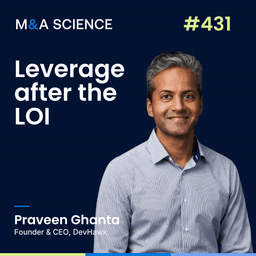
The Seller's Power Shift: How to Defend Valuation After the LOI
<p >Praveen Ghanta, Founder and CEO of DevHawk</p> <p >Twenty-four hours before diligence expired, the buyer's board came back and cut the offer by almost 50%.</p> <p >Praveen Ghanta bootstrapped HiddenLevers to over $8M ARR at 52% EBITDA and signed an LOI at 16x ARR. Then a $2M enterprise contract with TD slipped, and the private equity owners behind the buyer, Orion, took an ax to the price. Praveen walks through three rounds of renegotiation, setting a walkaway number, and landing around $130M with a small earn-out.</p> <p >He also covers what to define in the LOI before exclusivity...
