

Wikistrat Insider
Wikistrat Insider is a podcast series featuring in-depth discussions with members of our community, which spans over 5000 experts in a wide range of fields: from technology to geopolitics, health, and the future of work. We focus on the less-discussed angles of the most significant events happening around the world, to give you the insiders' scoop.

10
The US-Iran Deal: What's Next?
<p>A war launched to dismantle Iran's nuclear program has paused with Iran's enriched uranium stockpile intact, its grip on the Strait of Hormuz tighter than before, and a ceasefire document that has already triggered calls for Araghchi's head in Tehran and accusations of capitulation in Washington. On June 17, Wikistrat invited Dr. Sina Azodi, one of the leading voices on US-Iran relations, to assess what the MOU actually establishes, whether Iran will go nuclear, and why Iran emerges from the war more confident than before</p>

Operation Epic Fury: Implications for the Middle East
<p>Seventeen days into Operation Epic Fury, Iran controls the Strait of Hormuz, the U.S. has no credible exit strategy, and the Gulf States are trapped in a war they never wanted. On March 18, Wikistrat invited award-winning journalist Dr. James M. Dorsey to assess why escalation is more likely than resolution, what President Trump's shrinking options look like, and why the post-war Middle East will be shaped less by who wins than by what Iran looks like when the shooting stops</p>
The War in Iran and the Future of the Gulf
<p>For years, the Gulf States sold the world on stability, investment, and distance from the Middle East's wars. Two weeks of Iranian strikes have shattered that narrative, targeting population centers, energy infrastructure, and military installations across the Arabian Peninsula. On March 12, Wikistrat invited Gulf and Middle East geopolitics expert Dr. Neil Quilliam to examine how the GCC is absorbing the shock and what the post conflict landscape means for the region's security, economy, and diplomatic future</p>
Operation Epic Fury: Decoding Sentiment Inside Iranian Society
<p>The U.S.-Israeli air campaign has entered its second week, and Washington is looking to declare victory. But the Islamic Republic is intact, a successor is in place, and Iran's strategic calculus is already oriented toward reconstitution. On March 10, Wikistrat invited expert Ahmad Hashemi to assess the regime's wartime resilience, the hereditary succession, the failure of the opposition, and why no amount of bombing will produce the political transformation that Washington and Jerusalem expect</p>
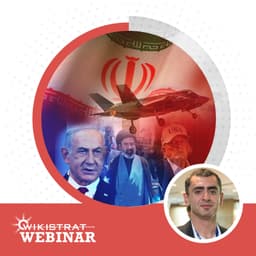
Iran at War: Survival, Succession, and What Comes Next
<p>Six days into the U.S.-Israeli air campaign against Iran, the strikes are producing battlefield results, but the strategy for what comes next remains undefined.. The Islamic Republic is battered, decapitated at the top, and under unprecedented pressure, but it is functioning, adapting, and drawing on a survival playbook decades in the making. On March 6, Wikistrat hosted Iran expert Dr. Sina Azodi for a webinar examining the regime’s wartime resilience, the looming question of leadership transition, and the strategic uncertainties surrounding Iran’s future</p>
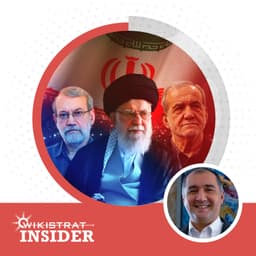
Operation “Epic Fury”
<p>Three days into Operation “Epic Fury,” the reported death of Ali Khamenei has redirected attention from tactical developments to questions of succession and institutional durability in Tehran. On March 2, Wikistrat hosted renowned expert Alex Vatanka to decode who runs Iran now, whether regime change is strategy or wishful thinking, and why the silence in Tehran's streets may be the most important signal of all</p>
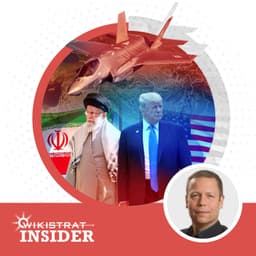
On the Brink of War: Iran, the US, and What Comes Next
<p>Iran's Supreme Leader faces what may be the defining decision of his tenure: capitulate to American demands and risk looking weak enough to invite future attacks, or absorb a U.S. military strike and bet that the regime survives it. According to Dr. Raz Zimmt, Khamenei has already made his choice. On February 27, Wikistrat hosted one of Israel's leading Iran experts, who laid out why a military strike is now more likely than an agreement, and what it could mean for the regime, the region, and the balance of power in the Middle East</p>
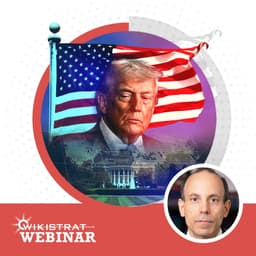
Marking One Year of Trump 2.0
<p>Donald Trump's second presidency has reached the one-year mark without triggering the catastrophic outcomes many predicted, yet without resolving the fundamental tensions his approach creates. Alliances strained but held, tariffs disrupted trade flows without collapsing them, and military force was deployed in sharp bursts rather than prolonged campaigns. On January 26, Wikistrat hosted Dr. Richard Weitz to examine what this volatile first year reveals about Trump's foreign policy instincts, how the world has adapted to his methods, and what the remainder of his term is likely to look like</p>

Iran's Social Unrest and the Future of the Regime
<p>Thousands dead, internet blackouts, and a currency in freefall. When merchants in Tehran's upscale Monet Street shopping center closed their stores on December 28, 2025, they triggered something the Islamic Republic hadn't faced in its 46-year history: sustained, nationwide protests met with unprecedented brutality. With over 2,000 casualties, a collapsing economy, and an 86-year-old Supreme Leader whose refusal to compromise has left the regime with no exit strategy, Iran finds itself at a crossroads. On January 13, Wikistrat convened Iran experts Dr. Sina Azodi, Ahmad Hashemi, and Alex Vatanka to assess whether this time is different and what comes next</p>

Is Taiwan the Next Ukraine? Scenarios for the Decade Ahead
<p>Taiwan is not on the brink of a 2027 invasion; the real danger is unfolding quietly in the gray zone. In this NYU Riskathon-exclusive webinar, Dr. Minxin Pei dismantles the widely accepted countdown narrative and argues that Beijing's most destabilizing tools are already in motion, from coercive military drills to pressure on undersea cables and commercial air routes. The flashpoint ahead is not the date everyone cites, but the political convergence of 2028, when elections in Taipei, Washington, and across the region collide with a Chinese leadership refining hybrid warfare options that stop short of war yet carry strategic shockwaves. Far...
